


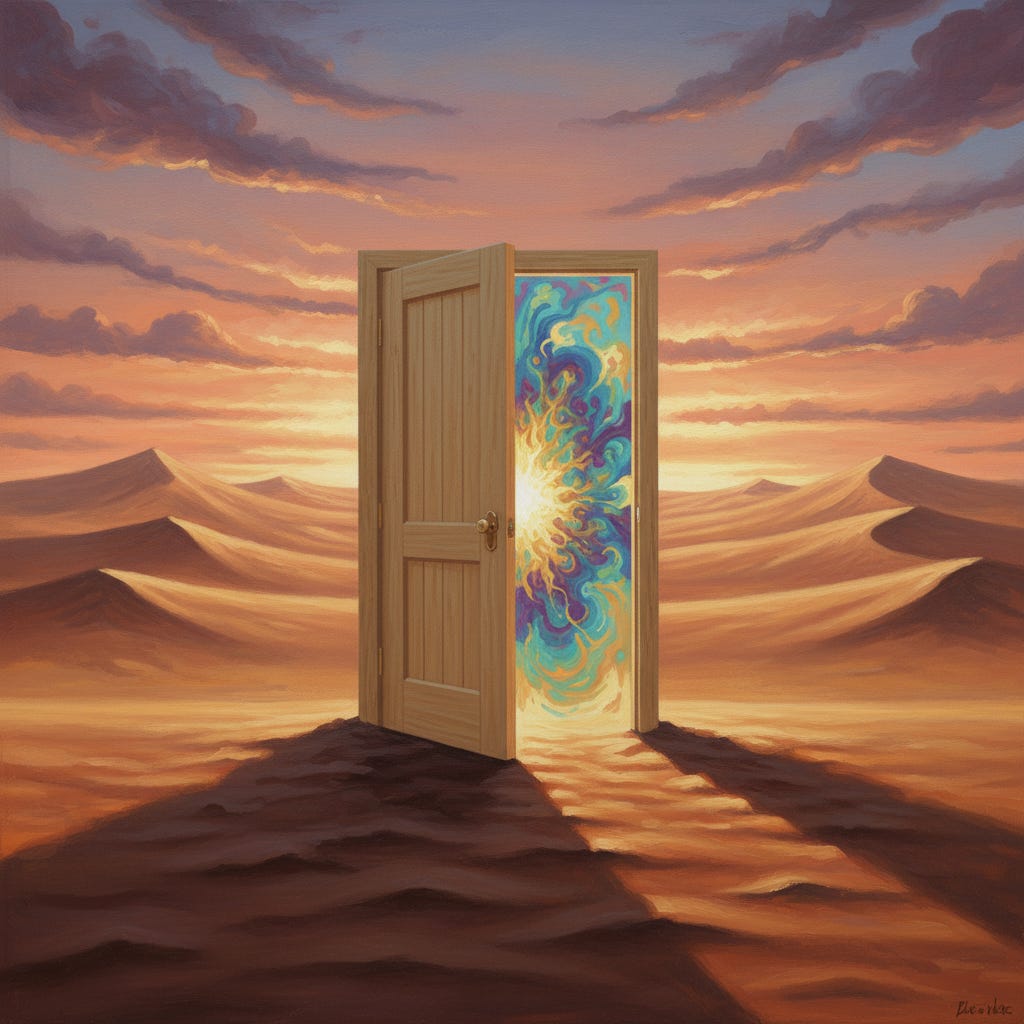
A family stands in the doorway of a room. The face staring back at them from the bed is the face they have known for decades. The person who used to live behind that face is not there anymore. The body keeps eating, keeps breathing, sometimes keeps talking. The person is gone, or going, or comes back for ten minutes on a random Tuesday and then is gone again. Anyone who has sat with Alzheimer's in a family member knows the specific weight of that room. It is not grief in the normal shape. It is grief while the person is still in front of you.
I worked several years in long-term care as a nursing assistant. Not the best pay, but truly meaningful, and I loved it so much I pursued further education and training to become a vocational nurse. Later, nursing home administration. Eventually, ICU admissions and administration. Same question, different rooms.
The ICU is the acute version. Bodies that keep running on machines while the person stopped being there hours or days ago. Then the other thing, the one nobody on shift gets used to. Terminal lucidity. A patient who has been somewhere else for weeks comes back sharp and present, talks to their son or daughter, says the thing they needed to say, and dies that night. Whatever was missing for those weeks was, briefly, back. And then it wasn't.
After enough years across that arc, the question stops being mystical and starts being structural. What part of a person IS the person? Where does it live, physically? When does it stop being there? Why does someone with Alzheimer's stay recognizably themselves for a long stretch and then, on some unmarked day, stop? Why does one person wake up from a coma the same person, and another person wake up as someone else? It is not "where did they go." It is "what configuration has to hold for them to be here at all."
If I'm honest the question was there before any of this. Long before. Weird things happened when I was a kid that I couldn't fit into any standard categories. The home I grew up in offered us many strange occurrences. What would be referred to as the "paranormal." I dislike that word, paranormal; and I’ve always wondered if what happened there had a scientific explanation. That maybe what we encountered was not only real, but somewhat normal. Something complex, yet mathematical. Something measurable, yet dynamical. The work in long-term care and the ICU just gave the question a vocabulary and a clock.
The question kept reformulating until it went math-shaped. Complex systems. Information theory. Integration. Differentiation. The conditions under which a pattern stays itself across time. I taught myself the engineering. Four papers in, and the framework has a name. The Dynamic Existence Threshold. The mechanism may be general. Cellular automata. Neural networks. EEG data. Transformer activations. Solar storms. Markets right before they come apart. Same form, every time. Some patterns hold their shape. Others don't. There is a clear, measurable line.
The work has an institutional home. I founded the Institute for Complexity Science and Advanced Computing, ICSAC, to publish open and to serve as the citable anchor for cross-substrate work like this. Papers live on Zenodo, CC-BY, free to read and free to break; and I didn't make ICSAC just for me — just because I've been rejected by more journals than I can count — I made it for the vast number of those like me. Independent researchers. Citizen scientists. Those whose work is unaffiliated with any institution or big agency, but is just as rigorous. Those who may be lacking a specific niche word, or term, but understand and demonstrate proficiency in their research. Most importantly, for those who simply can't afford APCs and Author fees. The code for the ICSAC's AI-assisted peer review program is always available for public inspection on GitHub and HuggingFace. I saw a pattern with journal publishing that should no longer be ignored, and ICSAC is my attempt at a fix.
The research happens in the margins of running 3Rivers WebTech, the small tech consultancy I operate here in Fort Wayne, Indiana, while attempting to dodge the eye-rolls and sassiness of a teenaged daughter.
This newsletter is for the work that isn't ready to be a paper. Or, isn't professional enough to be a research paper. Dispatches from somewhere in the middle. Where math, computing, small business ownership, dad-life, and the kid asking why the moon influences ocean tides, all sit at the same dinner table. Consciousness, complexity science, AI, fatherly advice, and the math of what persists. That last clause is the spine.
The reason any of this matters: the people we love come apart, one way or another. Slow in a long-term care room. Fast in an ICU bay. Eventually, completely. Understanding the shape of that, what the configuration is, when it holds and when it doesn't, might be the only honest thing we can do about it. The rest is just being there in the doorway.
If this resonated, forward it to one person who’d want to read it