


The claim
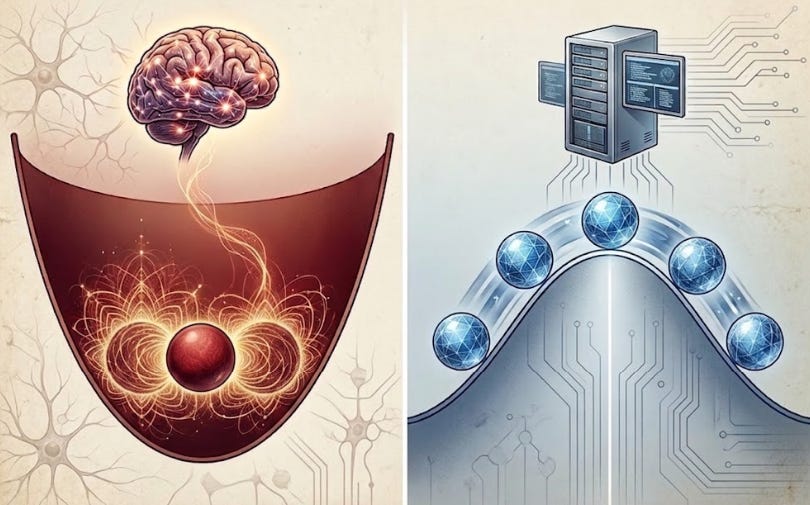
Put a rat or monkey brain and an AI model on comparable work, then ask the same simple question of each: how much of what's happening right now came in from outside, and how much is the system running on its own?
Every brain recording came out mostly running on its own. All five AI models came out mostly driven by input. That isn't a small gap, it's two different modes.
In rats there's a point in every trial where the animal makes up its mind, and right after that point the self-driven part gets stronger instead of fading. It has already chosen, and then it holds the choice even harder. A model produces its answer and just stops, there is no after.
None of this says anything about consciousness, in either direction. Deciding something is not the same as being aware that you decided it.
Three public datasets were used showing rats and monkeys deciding things, recorded by three different labs, already picked over by the people who recorded them.
I ran one measurement across all three of these datasets, then ran the same thing on five AI models working through multi-step questions. Not a difference of degree. Completely different regimes.
— full preprint available at https://doi.org/10.20944/preprints202608.1095.v1 —
Behaviour can't answer this
Take any network that loops its own activity back around and you can build one that never loops and behaves identically, same answers, same accuracy, no loop anywhere inside it. Old result. It's also the reason this work exists, because if two systems act the same and only one has recurrence, watching what they do will never tell you which is which.
So you go inside the system. At each moment a population's next state is partly explained by what just arrived at it and partly by what it generated itself, and the measurement pulls those two apart.
Break it before you trust it
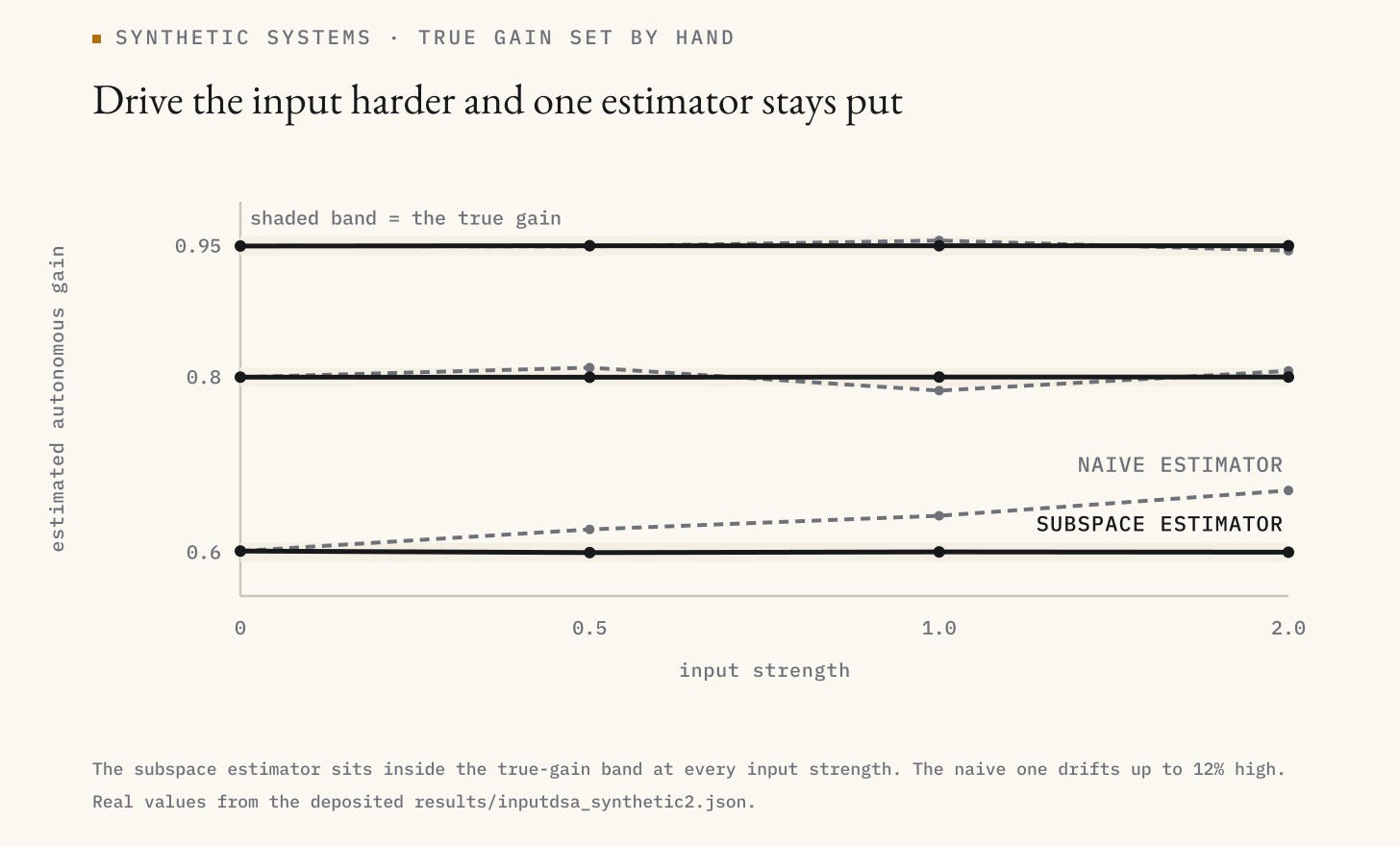
Before I pointed it at anything real, I ran it on systems I built myself, where I already knew the true answer and could see whether it came back. It did, every time, including when I drove the input hard enough that it should have broken. The method most people reach for instead drifts up to 12 percent off under the same conditions.
Where it gets strange
Every biological brain dataset came out autonomous-dominated. All five AI models came out input-dominated. No overlap. The absolute levels aren't comparable across substrates and I don't want them quoted as if they were, because "input" means a task-derived evidence signal on one side and a full embedding layer on the other, which is stated in the Methods in plain words.
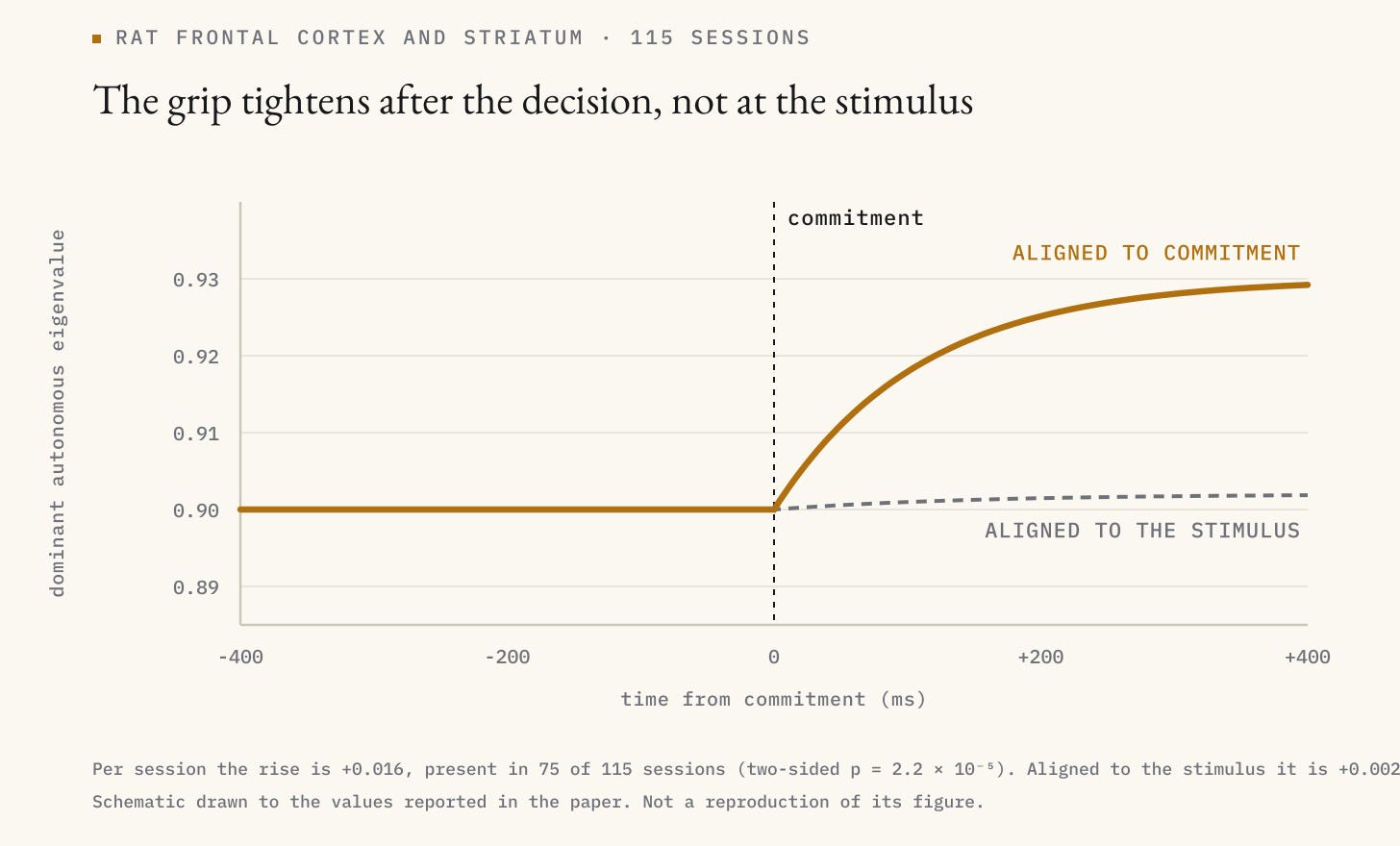
Rats running an evidence-accumulation task have a measurable instant on every trial where they make up their mind. Line the recordings up on that instant and the autonomous component climbs, flat at about 0.90 before, up to about 0.93 within a quarter second after. Line the same recordings up on when the animal saw the stimulus and you get 0.002.
It isn't reacting harder to what it was shown. It commits, then tightens its grip on a choice it has already made, in 75 of 115 sessions. Models finish at the last layer. A forward pass has no window after the decision for anything to tighten in.
The tests that could have killed it
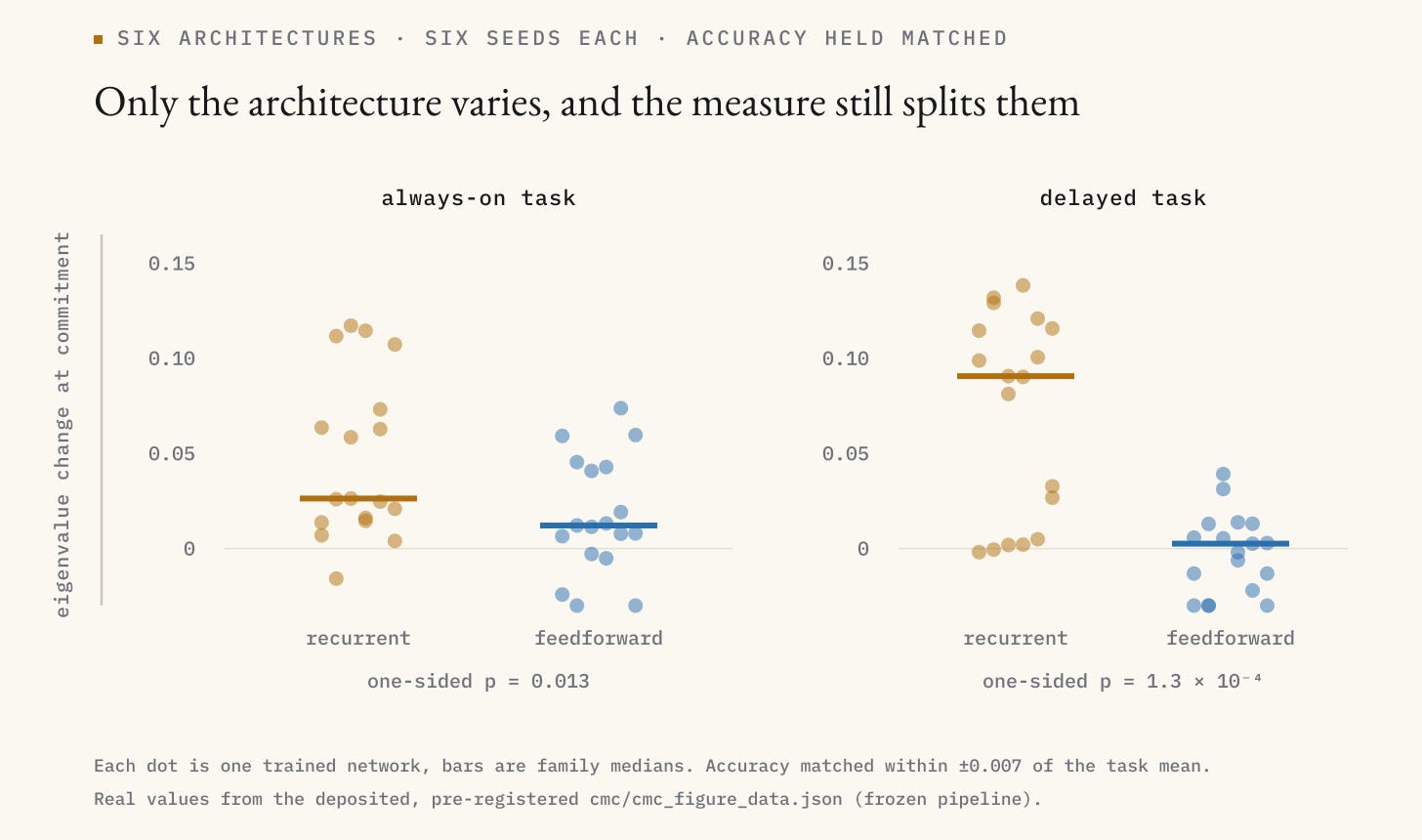
Written down and frozen before the numbers existed. The nastiest varied only architecture and held accuracy matched, three recurrent networks against three feedforward ones, six seeds each, same task, and it told the two families apart. Architecture, not task difficulty.
The rest were nulls and came back null. Split the same cortical data by committed against abandoned, or opt-in against opt-out, or against a scalar confidence proxy trial by trial, and the effect is gone. A transition locked to one moment gets smeared away the instant you average across trials, and averaging across trials is how this data has always been read.
Is this a mammal thing?
Fair question. I can't answer it. Every recording here comes from a rat or a monkey, two species off one branch, mostly cortex, and whether this is something mammalian cortex does or something any sufficiently recurrent nervous system does, nobody knows. Crows solve problems that look cortical without a neocortex to solve them with.
My one piece of evidence points away from cortex being special and it's the control, which has no biology in it at all. Six architectures, no neurons anywhere, and the measure still separated the recurrent ones from the feedforward ones. A gated recurrent unit is a few hundred lines of arithmetic with a loop in it. If this tracked something uniquely mammalian, that loop shouldn't have been enough. So my guess is recurrence, not mammal. A guess is all it is.
Check it yourself
Every dataset is public: rat orbitofrontal on Zenodo, monkey entorhinal on DANDI, the frontal and striatal Neuropixels data on Dryad, commitment times from the Brody lab's own repository. Code, derived tables and the pre-registrations are in the supplementary archive on the preprint.
If a number here is wrong, tell me and I'll fix it. If you work on population dynamics and think the demix measures something other than what I say it does, let me know: research@nathanthornhill.com.
~ If you know someone who may enjoy reading this article, please share ~
Sources
The preprint: https://doi.org/10.20944/preprints202608.1095.v1
Rat orbitofrontal cortex, value-based decisions: https://doi.org/10.5281/zenodo.16997337
Rat frontal cortex and striatum, decision commitment: https://doi.org/10.5061/dryad.sj3tx96dm
Monkey entorhinal cortex, mental navigation: https://dandiarchive.org/dandiset/000897
The estimator this builds on: https://arxiv.org/abs/2510.25943