


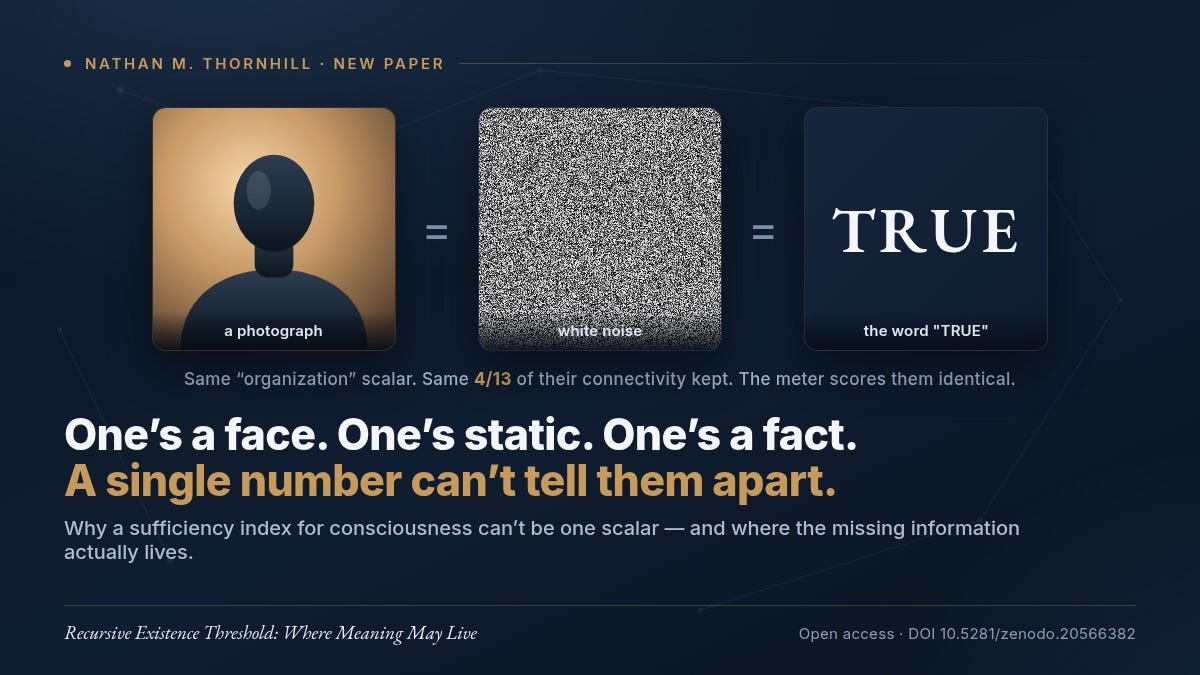
Take a photograph, a screen of TV static, and the single word "TRUE." Match them on density. Now run all three through the one number — "organization," "integration," pick your branding — that keeps getting floated as a meter for whether something is conscious.
Same score. All three. They even keep the identical 4/13 of their connectivity. One is a human face. One is noise. One is a fact about the world. The number can't tell them apart.
That's not a calibration problem you fix with a better dataset. It's structural. A substrate-neutral scalar is content-blind by construction. It was never going to see the difference, because the difference isn't in the magnitude, it's in the shape.
So I stopped arguing about it and went looking for where the information the number throws away actually lives.
Three substrates, one test
I pre-registered the whole thing. Wrote down what would count as a win and what would count as a loss before I touched the data. No moving goalposts.
A language model. Whether a statement is true or false is sitting right there in the residual stream — a plain linear probe pulls it out at 83% AUC. The famous scalar? Blind across all 29 layers. The truth was in the structure the number discards.
An anaesthetized brain. You can decode which person a recording came from out of the connectivity alone. The scalar sits at chance. Identity lives in the structure, not the number.
Sleep. There's a recurrence signal that survives even after you statistically subtract the scalar out; every fold, across five stage contrasts. It refuses to collapse into one number.
Now the part I could've buried and didn't. My own favorite idea going in was that recursion (a system folding back on itself) would make the structure measurably sharper. On one substrate that came back marginal. On the next, flat null. It's in the paper, reported exactly that way. A result you have to talk yourself into isn't a result, and I'm not going to dress it up to make my hypothesis look better.
So here's my challenge
Anyone who still thinks a mind reduces to one number: take your scalar. IIT’s Φ, PCI, whatever you trust. Residualize it out of your data, fold by fold, and see if anything that matters survives without it. If it does, your number was never sufficient. It was riding on structure it couldn't see. The test is in the paper. The code is public (https://github.com/existencethreshold/recursive-existence-threshold). Go.
The conclusion fits in a sentence: whatever "conscious enough to count" turns out to mean, it cannot be a single global number. What the number leaves out isn't the substrate. It's relational structure. The multiply-realizable kind a transformer's residual stream and the brain's thalamocortical loops both happen to carry.
I didn't come to this from a lab. I came to it from healthcare, watching consciousness arrive and leave at bedsides for years before I had any math to hang on it. No university, no grant, no permission.
The paper's free and open. Read it, break it, tell me where I'm wrong: https://doi.org/10.5281/zenodo.20566382
If this is the first you're hearing any of it, the four papers it grew out of are collected in the paperback and ebook Foundations of the Existence Threshold. That's the, well … foundation of it all.
Then tell me in the comments: if meaning had to ride on one number, which would you pick? And what would it miss? I read everything. Restack it if it made you think.
~ If you know someone who may enjoy reading this article, please share ~